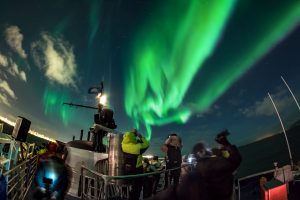
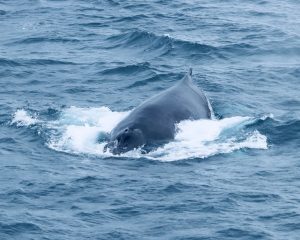
So, you’ve made your decision. You’re going to cross something major off your bucket list and go on a hunt for the Northern Lights. And best of all, you’re travelling to Iceland, the most beautiful country in the world! (Of course, I might be a bit biased.) My name is Jonathan Rempel, and I’m the Head Guide at Special Tours, the longest-running boat tour company in Reykjavík, Iceland. I’m now entering my 3rd winter of guiding Northern Lights by Boat tours here, and although I like to think I’ve seen it all, the fact is that these tours surprise and excite me in new ways all the time. I wanted to share some information and tips with you that might help you in your hunt.
When can I see the Northern Lights in Iceland?
First of all, in order to view the Northern Lights, the conditions must be right. You must have skies that are at least partially clear, as too many clouds can cover the Northern Lights up and make them impossible to view. It must also be dark enough to see them – and in Iceland, it doesn’t get dark at night in the summer! To be able to see the Northern Lights in Iceland you must visit sometime between late August and late April. When hunting for the auroras, you want to start by escaping any light pollution by leaving towns and cities behind. After that, the rest of the formula is just patience, and luck. The Northern Lights are a completely natural phenomenon, so nobody has any control over them. They are not guaranteed, as they can vary, just like the weather.
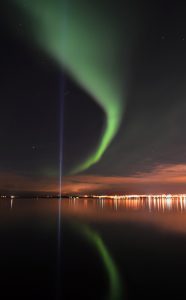
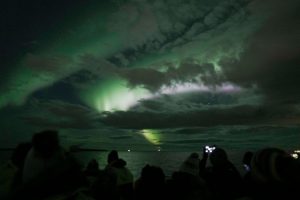
Northern Lights tour options
There are so many ways to try and see the Northern Lights in Iceland. Countless companies offer bus tours, or you could rent a car and hunt for them yourself. And then there’s us – we take to the seas to hunt for the aurora. But why should you consider taking a boat to see them? Well, in a few words, it’s way more fun.
The fact of the matter is, the chance to see auroras from the sea is not higher than on land. In fact, the chances are usually very similar. But to see why being on a boat is better, imagine the following situation: You’re on a bus tour to see the Northern Lights. You board the bus in Reykjavik with 70 other people, and drive for 1-2 hours to leave the city. During that time, you’re stuck in your seat, and you can’t go outside until you reach the destination. Once you get there, finally you can stretch your legs, breathe deep, and hopefully enjoy the show… before having to be stuck in your seat for another 1-2 hours on the way back. And hopefully you dressed warm enough, as well.
Why go hunting for the Aurora Borealis by boat?
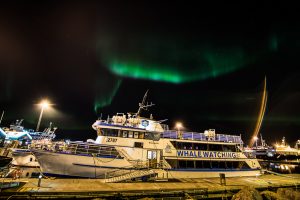
Being on a boat with us opens up so many possibilities. We depart from the Old Harbor in Reykjavik, just a 5-minute walk from the city center (but if you’re staying farther away, we offer an optional pickup and drop-off service to major hotels and guesthouses). All our passengers can borrow our wonderful thermal overalls for free, which can make it feel downright cozy when sitting or standing outside. On our way out, you get a chance to view the magnificent Reykjavik city lights and the Harpa concert hall from the sea, which is a great start and end to the tour. We have a cafeteria and a bar on board with a nice variety of snacks and drinks, and plenty of restrooms. You are always free to move around anywhere you wish, inside or outside, from the moment you step on board. And the best part – every tour comes with a fantastic and experienced guide to tell you all about the science and magic behind the Northern Lights! We aren’t the only company in Reykjavik offering Northern Lights by Boat, but we were the first company in Iceland to do so. That gives us a lot of experience, which we are happy to pass along to you. Plus, being on a boat is awesome! But again, I’m probably biased.
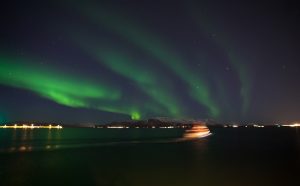
What to bring with you on a Northern Lights by Boat tour?

What kind of a camera to use to photograph the Northern Lights?
The best type of camera to capture the Northern Lights with is a DSLR or mirrorless-type camera – so think Nikon, Canon, Sony, or similar. All too often, I see people bringing small point-and-shoot cameras on these tours, only to be disappointed by the results. The problem is that cameras like these, and most smartphone cameras, have very small sensors that don’t support manual settings. If you really want to try anyway, you could try to set your camera to Fireworks mode, and hope for the best. There are several smartphone apps which could potentially be used to photograph Northern Lights, including Northern Lights Photo Taker, Nightcap, and others. But these depend mainly on your own phone, as they are not all created equal!
Camera settings to photograph the Northern Lights
Here I will go over the best settings for capturing auroras on a camera that can be set to manual mode. The best settings for Northern Lights photography on land will be quite a bit different than on a boat – mainly because the boat is moving! So here are the settings you should use:
Just note that the optimal settings can vary between cameras, and between aurora conditions. I recommend consulting your camera’s user manual for instructions on how to change specific settings if you aren’t sure. During our boat tours, our experienced guides are always standing by to help you out as well, if you need it.
How to read into the Northern Lights Forecast
If you’ve done some research into hunting for the Northern Lights, then you might have heard that aurora activity can be measured using a scale from 0 to 9, called the Kp-index. You may be crossing your fingers extra hard for higher numbers during your trip to Iceland. On most nights, this activity is around a 2, which sounds low when you first hear it. This scale does measure aurora activity, but it could also be described as a way to measure how far south auroras can be seen. The higher the number, the farther south one might view the Northern Lights. And because Iceland is relatively high in latitude – around 64 degrees North around Reykjavik – even very low numbers are enough for nice displays. But the thing is that we don’t pay much attention to those numbers, as we find they are not always a good indicator for how the auroras will appear. For example, I have personally seen stunning displays with swirling green and pink when the Kp-index was a 0 – and we have once gone out when the Kp-index was a 7, and we saw nothing. Your experience can certainly vary.
When our experienced team makes their decision whether to go out or not on a given night, they check several weather forecast websites, with the main one being the official Icelandic Meteorological Office – you can check it out yourself at en.vedur.is. We only ever decide to go out if the chances of seeing the auroras are good – something that we’re very proud of! Because the forecasts for cloud cover can change so quickly, we always make the decision the same day as the tour, and often it will be late in the day, so we can base our decision off the latest forecasts. We usually make our decision around 16:00 (4 pm) each day, so our passengers can plan their evenings with enough notice. If we do decide to cancel due to unfavorable cloud cover, you are always welcome to reschedule for another night.
Free ticket to try again in case of no sightings!
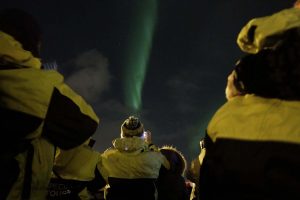
Just remember that the Northern Lights aren’t always there. In a way, that makes them even more special – that they require patience, and hunting. But just in case you come on a tour with us and don’t get lucky with seeing the aurora, then you will receive a free ticket to try again, an offer that never expires. We therefore recommend coming on a tour as early in your vacation as you can – that way, you have more chances to see them. You can book your Northern Lights by Boat tour online, and if you have any further questions related to our tours, feel free to contact our ticket office by email at info@specialtours.is or just call +354-560 8800.
I wish you good luck, and happy hunting!
Jonathan Rempel
Instagram: @jon.rempel
Special Tours Head Guide
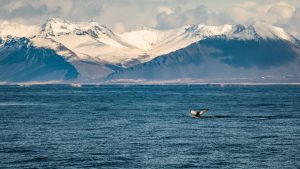
Whale watching is probably the ultimate wildlife experience, and certainly one of the most difficult challenges that I faced as a wildlife photographer.
Whales spend most of their time underwater but of course, being mammals themselves they must surface to breath. This gives us a small window of time to enjoy them and possibly take some fascinating photos.
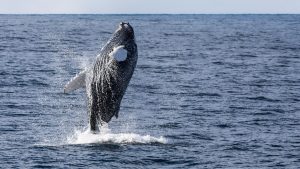
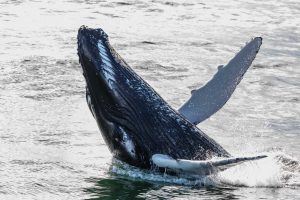
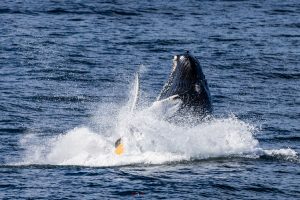
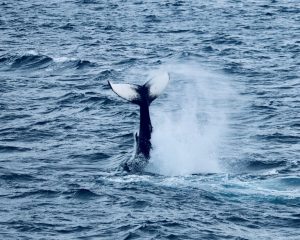
Sometimes cetacean can breach too! Even a huge humpback whale, a 40-ton animal, can launch itself high in the air becoming one of the most breath-taking natural shows I’ve ever seen in my entire life.
Nevertheless, this rare and spectacular event takes about 1 second, and doesn’t happen very often. Most of the time it happens in just a flash, a blink of an eye and if we are not 100% ready, we will not be able to enjoy it. So, you can imagine how hard it can be to take a good picture of it.
Here a few tips that may be of help for those of you who want to go back home with an epic homemade postcard from Iceland.

Pictures by: Federico Facchin
First of all, it is good to know that to photograph whales breaching you do not need fancy equipment. Of course professional equipment, if properly used, gives us better quality images, so let’s take a moment to speak about cameras, lenses etc.
Camera body:
Definitions, shutter speed, and ISO sensibility are among the most important parameters to judge a camera body.
Most of the entry level cameras can shoot at 1/400 sec. Professional cameras shoot at 1/8000 sec but for my best whale shots I’ve worked with 1/1000 sec roughly.
Usually we go whale watching during the day, so there is enough light to satisfy the ISO performances of all the cameras.
Lenses:
Obviously we are going to need a zoom lens (unless the whale gets THAT close), but:
If the lens is too bulky and heavy it is hard to operate it, especially considering that you are floating on a boat, with waves shaking it.
You do not want to have too much zoom power, so I have been working with 200mm zoom. Perhaps 300 mm works good as well, but if you exaggerate it results very hard to be able to point the whale quickly enough. We do not need extremely bright lenses with large aperture, for example; f2.8. A humpback whale can get up to 17 meters, so at a wide aperture part of the body would be blurred.
Make sure to switch on the stabiliser (selectors mode 1 for the advance lenses). If your lens doesn’t have the stabiliser option, you can solve that problem with a monopod or with a faster shutter speed.
Filters:
Something that I found extremely important are the filters. I am not talking about Neutral density filters (ND) but I am rather suggesting you to get a Polarized Filter (PL).
To use a PL filter is not just important, it is sometimes fundamental! The reflected light has the characteristic to be polarised, a PL filter can absorb and “delete” it. When sunlight is mirrored from the surface of the sea, it becomes extremely bright and it tricks the digital sensor of our camera. Consequently, we might have wrong expositions and can burn the colours.
PL filter (if correctly oriented according to the sun), can absorb most of these reflexes and greatly improve the final result of the picture!
Note that PL filters can make a difference even on cloudy days.

Pictures by: Federico Facchin
That being said, equipment is not important if you do not know how to use it.
Personally, I want to have full control over the camera, and I always work on manual mode. Shutter speed ranges between 1/800 sec and 1/1250 sec. and believe it or not it depends on the sea conditions. If the sea is extremely flat, it might allow us to increase the time exposition and vice versa.
Aperture is something that can change a lot according to the size of the subject, the number of subjects we want to include in the area of focus for our shot and of course how close the animals are.
Wide apertures will focus only a small portion of what is in front of us, but if the light conditions allow it, we might be able to close the diaphragm and include more subjects in the same shots. Usually I shot at f 5,7 but as I said, it depends on many factors.
ISO and temperature must be regulated according to the light conditions of course. Although, in this case I usually rely on the automatic exposition.
Another important thing: make sure you select the burst mode, or continuer shooting mode, and to make sure the auto focus will not miss the subject, select AI Servo in the auto focus options. This way the camera will keep adjusting the focus point.

Pictures by: Federico Facchin
Since the breaching of a whale is such a quick event, and since we have so many other things to think about, we may not have the chance to think about the composition of the shot. Therefore, try to use the central AF point not to miss it, and you can always adjust the picture in the post production.
If what I told in the previous paragraph sounds like a foreign language, select the “sport” mode. It is meant to take pictures of fast moving subject and it should give you good results as well.
Now, to make sure not to miss the breach of a whale the two golden rules are: never give up and never let your guard down.
You must be ready for a big endeavour, as both body and mind will be under pressure. Patience is the key, and even if nothing has happened after two hours on the sea, it does not mean it will not happen!
Standing in a boat can be tiring, especially on a rough sea, and you must keep the camera in position! Do not put the camera down, especially when the expert guide on board tells you that there are likely whales in the area. Keep the camera pointed at the sea, where the guide believes there are more chances to see the animals.
A whale breaching happens in a flash, which does not leave time for the photographer to point the camera, adjust the settings, focus and shoot. The Camera setting must already be perfect, and the camera should be lifted too, so that you only have to point it in the correct direction, focus the subject and shoot! Keep the camera in position and keep adjusting the parameters, especially if the boat drifts and the relative sun position changes.
However, being able to use the equipment can be pointless as well if you are not lucky to have a whale breach in front of you!
I have been very lucky, as I could see my first humpback whale breaching through the camera’s eye. What I suggest you is to be patience, and as soon it happens, you must try and keep it cool to focus on the subject and shoot. It might be worth the best picture of your life!
Also, be ready to fail my friends. At the end of the expedition you will probably have dozens of blurred pictures and many pictures of splashes. But if you are lucky (and talented), you might also have a correctly exposed and focused picture of a whale above the waves.

Pictures by: Federico Facchin
Experience, patience, tenacity, and a bit of good fortune will permit you to shoot pictures like these on your next whale watching adventure with Special Tours – Wildlife Adventures in Reykjavík, Iceland.
Good luck to all of you whale watchers!
Federico
—————————–
Blog by: Federico Facchin

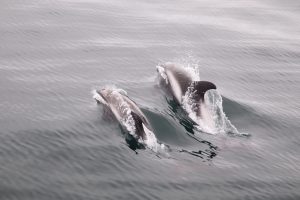
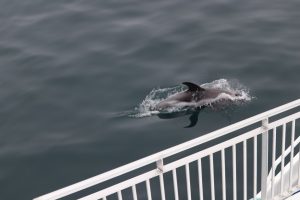
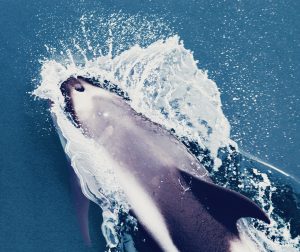
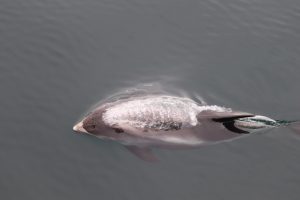
This blog has been inspired by the flurry of activity our white-beaked dolphins have been showing recently. White-beaked dolphins are one of our most active species and have stolen the hearts of most of our guides by riding the bows of our boats and jumping magnificently around us.
For those of you who want more than simply to indulge in the beauty of their leaps and bounds, we thought we would put together a little fact file for you.
Firstly, you will need to know how to tell the difference between a white-beaked dolphin and any of their cousins. The best clue here will always be the waters they are found in. These dolphins are one of the only dolphin species worldwide who truly appreciate the cold. Never found below England or Ireland, these eclectic individuals prefer water temperatures of less than 12 degrees Celsius.
Aside from this, they are known to have a much more robust body than other dolphins and a much ‘snubbier’ snout. Of course, the beautiful grey and white markings all along their bodies make them most identifiable when you can get close enough to really study them- and we often do, as they are frequently seen riding the bows of our boats here in Iceland!

We must, embarrassingly, admit that we actually don’t know all that much about white-beaked dolphins. We know that they are found in Icelandic waters year-round, and not just in Faxafloi Bay. We have been studying them for over twenty-one years (longer than the lifetime of our company!) but we still do not have a full understanding of their range and behavioural traits.
One thing that we can do is create a catalogue of all our known sightings. Dolphin species worldwide can be identified using high quality photographs that focus on the dorsal fin of a given individual. If you look closely at the fin in the photo below, you can see a small nick along the back edge. This cut will set this particular dolphin apart from others of its species and enable us to create a profile for him or her in the University of Iceland’s catalogue. In cases where the nick is particularly similar to another individuals’ markings, we then refer to their natural marking patterns. For example, this individual has a remarkable white stripe along the side, which would make them stand out from others easily.

The natural markings of an individual do not only tell us their ‘ID’, but they provide us with a good insight into the life history of the species including movement and social structure. Natural markings in cetaceans can be a result of parasites, predator attacks, anthropogenic activities or congenital activities, to name but a few. Some marks are more common and consistent than others, and really indicate the kinds of lives these mammals lead. To give a larger scale example, in Icelandic waters minke whales are often spotted with injuries indicating the attack of a cookiecutter shark, while this is extremely rare in the white beaked dolphins. This is because minke whales dive much deeper than the white-beaked dolphins and can hold their breath for longer. As cookiecutter sharks are a demersal species who prefer to spend time between depths of 1-3.7km and migrate vertically to depths only as shallow as 85m to feed, they are much less likely to encounter the much shallower-dwelling dolphins, and therefore bites are more common in minke whales.
White-beaked dolphins are one of few species whose ‘blotches’ on their dorsal fins appear to be permanent (while with others, they can tend to fade with age). In this way, we can utilize their unique spot patterns repeatedly over the years to understand the residency of our populations. It seems that this residency is indeed high, with some individuals spotted consistently throughout Iceland.
As long as you know what to look for, the dolphins can be quite unique. On our tours you might occasionally be lucky enough to encounter a particularly well-known individual, and your guide may already know him or her by name. Alternatively, if you are fortunate enough to see a mother with her young calves, it could be that you are spotting an individual who has never before been documented – and for that reason, you should always keep your camera handy on a Special Tours adventure!
by: Catherine Cushenan (Guide)
Ever wondered if whales can be identified? Keep reading to learn about humpback whale identification.
If you’ve been on one of our tours recently you may have noticed that amongst the accoutrement of radios, speakers and useful spotting equipment the guides keep with them, they also have a camera at the ready at all times.
There are a couple of reasons for this. One being so that we can opportunistically capture picturesque photos of the wildlife and the landscape to showcase the magnificence of our tours, allowing those of you who have an upcoming tour to get an idea of what to expect, and just how exciting life at sea can be. However, one of the more pivotal reasons that we are often spotted acting as snap-happy as can be is to help extend the scientific database of Icelandic whales.

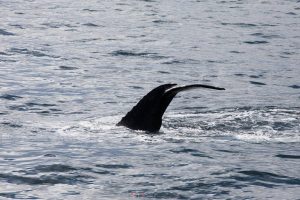
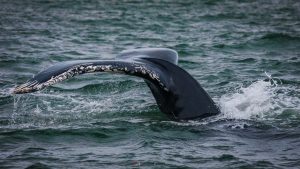
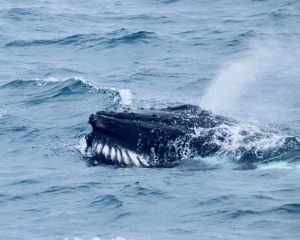
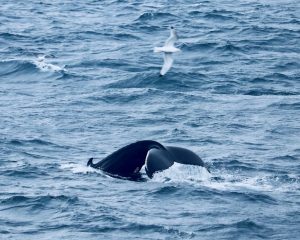
As of October 2017, 738 different individual humpback whales have officially been identified in Icelandic waters alone. The fluke (the underside of the caudal fin) of a humpback whale is always completely unique. A fluke to a humpback whale is the same as a fingerprint is to us humans (Brown et al., 2018). Since 1981, researchers, whale watching guides and tourists alike have been photographing humpbacks in Iceland and creating a giant database of all the mugshots that they can. You will be able to see from the photos attached here, as each photo shows a different whale with varied spots, blotches and nicks. Essentially, we are using photos to spot the difference and help us identify our fellow mammals.
Humpback whales tend to be separated into two groups: those who live in the Southern Hemisphere and those who live in the Northern Hemisphere. Humpbacks exhibit strong site philopatry, which means that they like to return to the same ‘holiday’ destinations every year. They are genetically programmed to consistently return to the same locations as their parents, and their parents before them to breed, feed and explore (Kowarski et al., 2018). Northern humpbacks spend their years migrating between the Arctic, where they love to eat krill, cold water fish and plankton in some of the most nutrient rich waters in the world, to breeding grounds such as Guadeloupe, the Dominican Republic, the West Indies and the Cape Verde Islands (Bertulli et al., 2018).

Using the photo ID database, local scientists were able to compare populations of whales passing through various feeding grounds in North Atlantic, such as West Greenland, Eastern Canada, the Gulf of Maine, Norway and here in Iceland. While we previously believed that the whales were facultative travellers (which would mean that they don’t mind where they go, as long as they get a snack wherever they end up), we now have evidence that there is extremely little overlap between individuals who visit each of the feeding grounds listed above. Of the 738 whales spotted in Iceland, only four have been seen in Norway- where a separate population of 752 individuals have been seen (Lavin, 2017). Just from photographic identification, we have been able to learn a little more about the behavior of these beautiful animals- and seen that their routine is a lot more diligent than we could possibly have imagined!
Hopefully this has given you some insight into the power of photography in marine research, and potentially has inspired you to bring your cameras on board with us. Who knows, maybe you will be the next person to identify a new whale in the area on one of our whale watching tours from Reykjavík, Iceland!
See more about humpback whales and how humpback whales feed here.
Blog and photos by: Catherine Cushenan (Guide)
References
Bertulli, C. G., Guéry, L., McGinty, N., Suzuki, A., Brannan, N., Marques, T., … & Gimenez, O. (2018). Capture-recapture abundance and survival estimates of three cetacean species in Icelandic coastal waters using trained scientist-volunteers. Journal of Sea Research, 131, 22-31.
Brown, D. M., Robbins, J., Sieswerda, P. L., Schoelkopf, R., & Parsons, E. C. M. (2018). Humpback whale (Megaptera novaeangliae) sightings in the New York‐New Jersey Harbor Estuary. Marine Mammal Science, 34(1), 250-257.
Kowarski, K., Evers, C., Moors‐Murphy, H., Martin, B., & Denes, S. L. (2018). Singing through winter nights: Seasonal and diel occurrence of humpback whale (Megaptera novaeangliae) calls in and around the Gully MPA, offshore eastern Canada. Marine Mammal Science, 34(1), 169-189.
Lavin, C. P. (2017). Photo-identification of humpback whales (Megaptera novaeangliae) between Iceland, Norway and Guadeloupe (Doctoral dissertation).
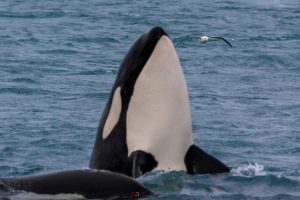
Killer whales in Iceland are a rare sighting. But earlier this month, we encountered a couple of killer whales or orcas on one of our whale watching tours here in Faxaflói, the bay off the coast of Reykjavik. Even though they do not belong to the species that we typically see in the bay, we would like to take this sighting as an opportunity to tell you more about them.
The two individuals that we came across a very well known: They belong to a pod (group) of orcas that travel between Iceland and Scotland (Northern Scotland, Shetland, and Orkney)! These seasonal movements were first reported in 2015 when seven orcas had been sighted in both places. However, in the meantime, the number of these intrepid orcas has increased to at least 20 that we know of. Still, it is a small number compared to the over 300 orcas that have been identified in Icelandic waters so far. This is known from comparing photos of orcas from both Iceland and Scotland. The dorsal fin and the gray saddle patch behind it look different in each orca – it allows the identification of individuals just like with human fingerprints. This is an important research method called photo-identification which is used on a variety of whale and dolphin species all over the world.
In other places like the East coast of North America, killer whales have been photo-identified for longer than here in Iceland. By having recorded individuals for more than 50 years now, we have learned so many things about their social life as well: They live in tight family groups that are typically led by the oldest female, i. e. the mother or grandmother of the family group. Her children and grandchildren will often stay with her for their entire lives – this is very special in the animal kingdom, only a few other cetacean species appear to live in similar family structures! The young ones learn their family´s hunting strategies, customs, and dialect over the first few years of their lives. Their lifespan is comparable to humans: Especially female orcas regularly live beyond their 60s and can live to be older than 100 years!
Orcas, in general, hunt a large variety of prey species, from fish, seals, birds, large whales, and other marine critters like octopi. However, each group has its preferences and Icelandic orcas are specialized herring hunters. While hunting herring, they emit a low-frequency call that makes the swim bladder of the herring vibrate. Studies suggest that herring react to these calls by forming a tight swarm which makes it easier for the orcas to hunt them. Typically, orcas use their fluke (tail fin) to debilitate the herring and then feed on the stunned fish. Therefore, the closer the herring swims together, the more effective are their tail slaps. The Icelandic Orca Project is doing great work studying our local populations and solving some of the mysteries revolving around orcas. We still have a lot to learn about them.
The IUNC (International Union for the Conservation of Nature), which maintains and updates the so-called “Red List” of endangered and threatened wildlife, classifies orcas as “data deficient”. That means that we do not have enough data on the species to evaluate their status and risk of extinction. However, some distinct populations of orcas, e.g. Southern Residents of the Pacific Northwest, are classified as endangered. Unfortunately, the outlook for many populations is rather grim. As an apex predator at the very top of the food chain, what can cause a problem for killer whales? The culprit is the pollution of our oceans with chemicals like PCBs. These substances were once widely used in paints, hydraulic fluids, coatings of electrical cables, and more. They are persistent and build up in the food chain through a process called bioaccumulation. The further up the food chain a species is, the higher will be the concentration of the chemicals they accumulate throughout their lifetime. In this way, their status as apex predators becomes a disaster for orcas. PCBs affect the animals’ immune and reproductive systems, leaving them prone to disease and infertility. A recent study predicts the collapse of many orca populations over the next 100 years. With each of them, we are in danger of losing a unique part of our marine ecosystems forever.
PCBs have been banned near-globally for more than 30 years. However, once these chemicals have leaked into the environment, they are extremely difficult to remove. The least we can do now is becoming better stewards of our oceans and make sure no other chemicals like PCBs keep polluting them.
Blog by Hanna Michel, Special Tours Guide