The Aurora Borealis, or Northern Lights, is undoubtedly one of the most spectacular and beautiful of nature’s phenomena. In classic mythology, Aurora was the Roman goddess of dawn, while Boreal is a Greek and Latin word meaning North. The Southern Hemisphere’s equivalent of the Northern Lights is the Aurora Australis. Auroras can sometimes occur at lower latitudes, even as far south as the equator, though this is a very rare occurrence. If you’re planning your holiday to see the lights, you’re probably wondering about the best time to see the Northern Lights in Reykjavik, Iceland? In this article, we help you find the best time for you.

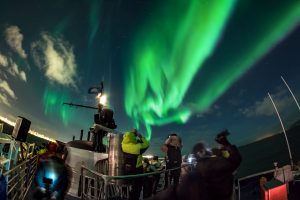
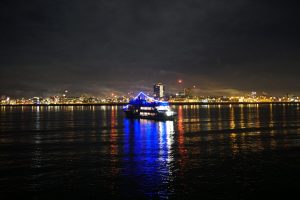
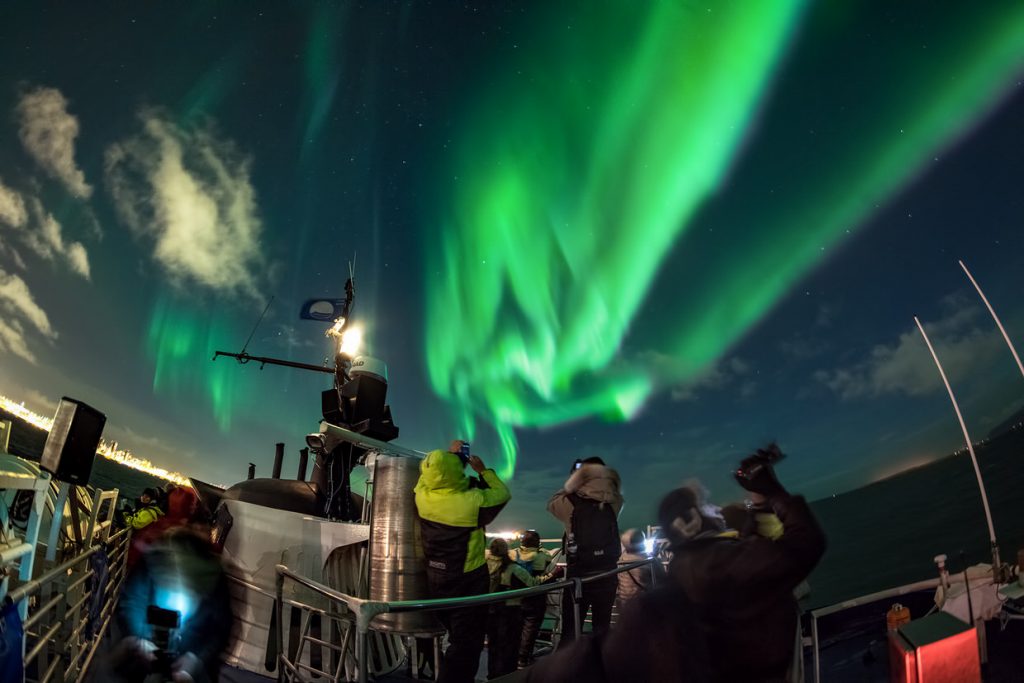
Northern Lights seen on a Northern Lights by Boat cruise from Reykjavik
In the summertime, it’s not possible to view the auroras due to the long daylight hours in the Northern Hemisphere. The aurora’s colors correspond to different types of gases in the ionosphere. Oxygen molecules give off green or red light depending on how high they are in the ionosphere, whereas nitrogen molecules give off blue or violet light. The most common color observed is pale green.

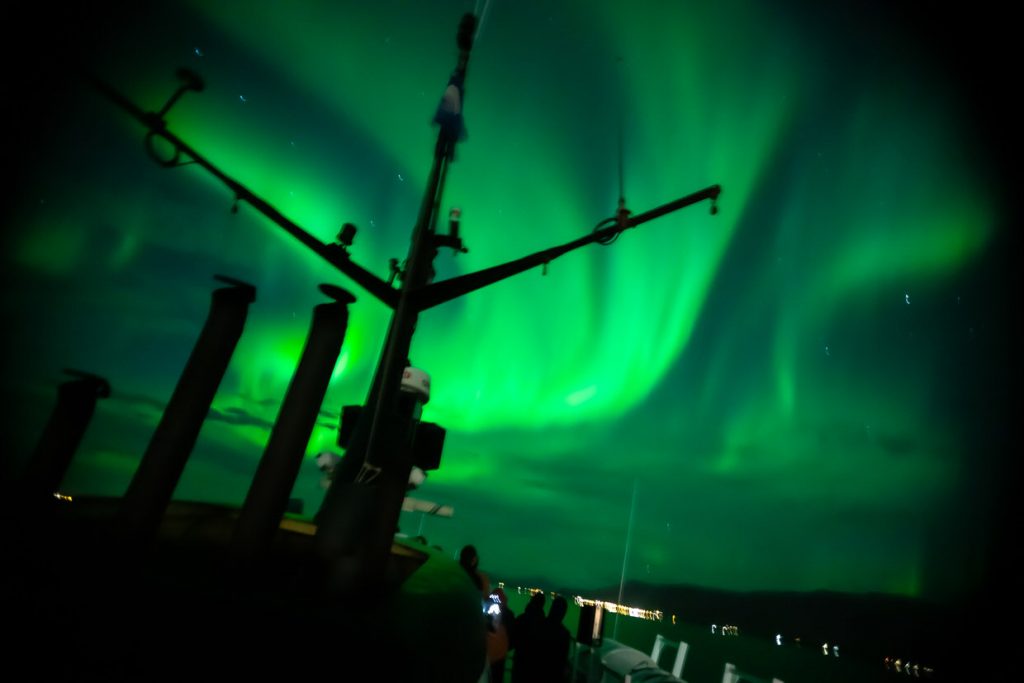
Northern Lights By Boat – sailing away from the city lights
Typically, a Northern Lights display lasts for a few minutes and occurs several times per night. Auroral activity is at its most intense during the hours before midnight and it just so happens to be that this is the time we sail out on our Northern Lights by Boat cruise from Reykjavik. Light pollution, particularly from city lights, can dramatically reduce visibility. So, for optimal viewing, enthusiasts should try and leave brightly lit areas. Even sailing traveling 10 or 15 minutes outside the city can significantly optimize you sighting chances and therefor your enjoyment of the Northern Lights.

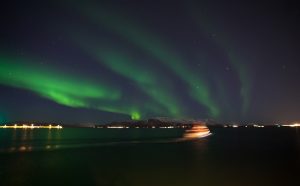
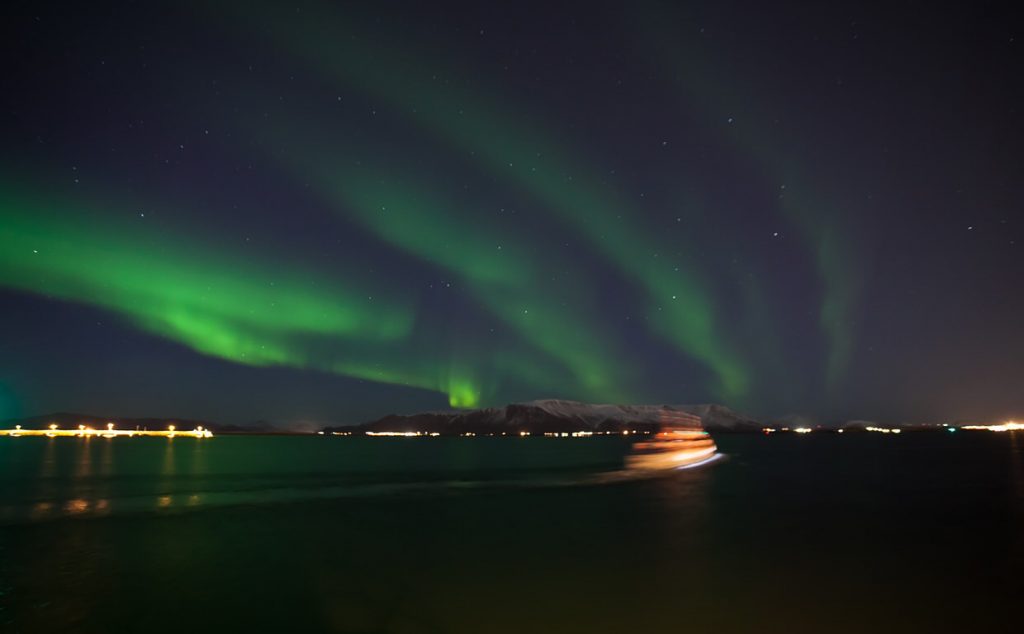
Aurora Borealis display seen from sea
We look forward to seeing you on our Original Northern Lights by Boat Cruise from Reykjavik this winter. In case of no sightings of Northern Lights on your tour, you get a free ticket to try again so we highly recommend booking this activity on your first night as that will highly improve your chances of seeing Northern Lights! In case your tour gets canceled due to unfavorable weather forecast please contact our office as we have an optional backup plan waiting for you. You don´t pay anything extra for the backup plan and you get to keep your ticket to join the Northern Lights by Boat tour on another night! On the other hand, if you want to include the backup plan in your ticket and pay less then book the Northern Lights by Boat with a backup plan.
All aboard for an Adventure!
Special Tours Wildlife Adventures from Reykjavik
How long whales live depends on the species and how well they have been studied, there is still a lot that we do not know about whales! Some of the oldest whales are also some of the largest whales and many of them can be found in Icelandic waters. Check out our blog on How Large Can Whales Grow? for more information.
The four most common cetacean species which we see on our tours are Minke Whales, White Beaked Dolphins, Harbour Porpoises and Humpback Whales. Out of those species Humpback Whales are the oldest with up to 100 years and Minke Whales can live up to 50 years! The life expectancy of White Beaked Dolphins is not well known, it is estimated to be between 40 and 50 years. Harbour Porpoises have been reported to live to 23 years of age (average 7 to 10 years).

A White Beaked Dolphin

A Humpback Whale

A Minke Whale
Blog by
Dr. Annemarie Kramer
Special Tours Wildlife Adventures Guide
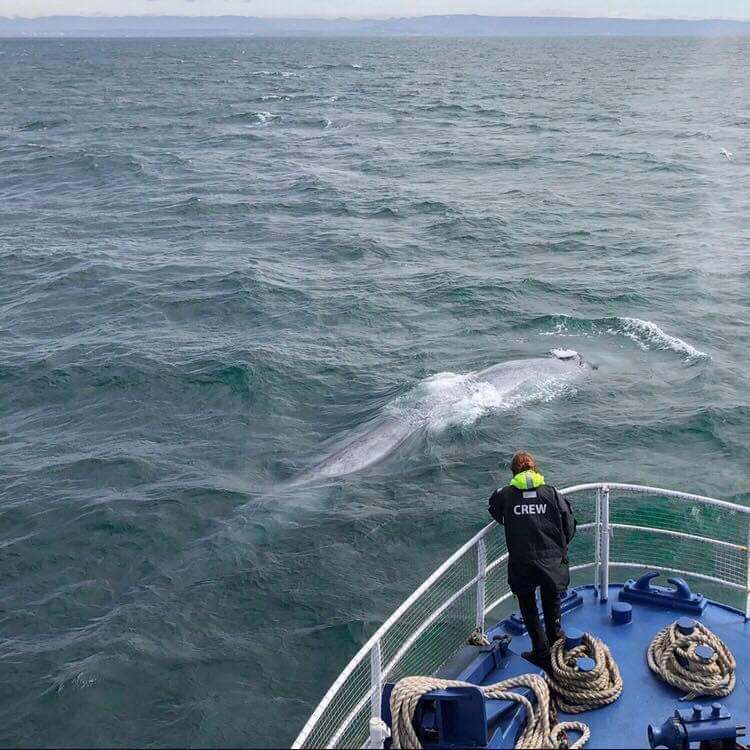
Whales are among the biggest animals which have ever existed on earth. The largest animal which inhabits our planet is the Blue Whale which has been measured to grow up to 33 m (110 ft). Newborn Blue Whales have been recorded to be around 7 m (23 ft) in size. Blue Whales are more frequently sighted in the North of Iceland but in Summer 2019 we encountered a blue whale mother and her calf in the Faxafloi Bay in one of our whale watching tours from Reykjavik, which was truly exceptional and is a once in a lifetime experience for most people!

A Blue Whale was seen on a tour with Special Tours summer 2019
The second largest whale is the Fin Whale, which can grow up to 26 m (85 ft) long. It can also be sighted around Iceland and has been encountered on our whale watching tours from Reykjavik in the Faxfloi Bay, even though it usually stays further off the coast in deeper waters.
The Sei Whale is a baleen whale as well and has been reported to grow up to 20 m (60ft), it is definitely the third largest baleen whale. Sei whales are also found around Iceland and very occasionally have come into the Faxafloi Bay!

“Sei Whale the third largest whale can grow up to 20 m or 60 ft. “
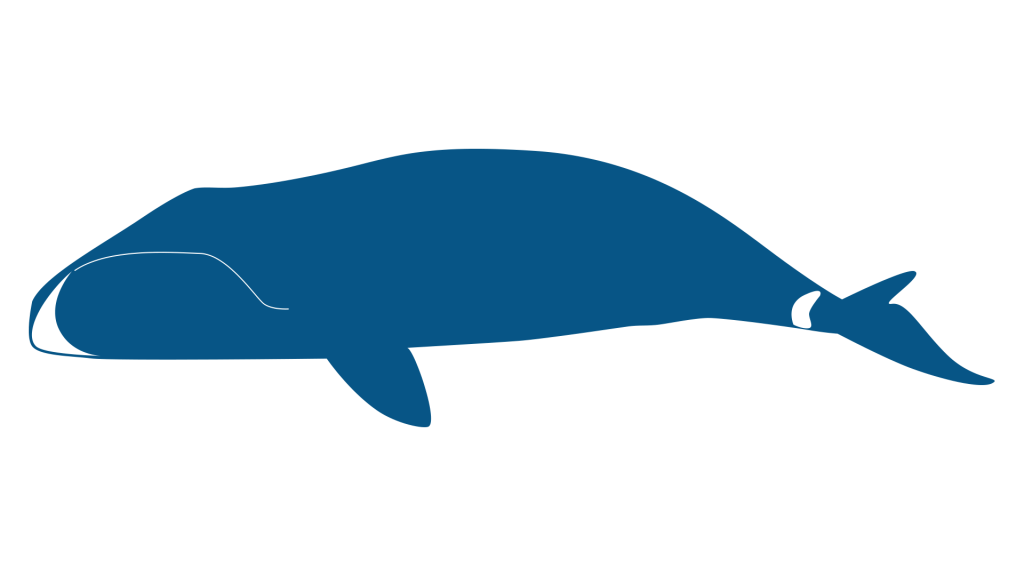
The Right Whale is a baleen whale of similar size; it has been reported to grow up to 20 m (60ft) as well. This whale has got its name because it was the “right whale” to hunt as it is moving slowly and has a lot of blubber (fat) in its body which was very valuable for the hunters. Unfortunately, this caused the species to be functionally extinct in the North Atlantic which means there are not enough individuals left to maintain its population and they will disappear. In summer 2018 a Right Whale ventured into the Faxafloi Bay, which hadn’t happened in 12 years!

The Right whale can grow up to 20 m or 60ft and was last seen on a whale watching tour from Reykjavik in the summer of 2018
All those large whale species which we mentioned so far are baleen whales which means they have baleen plates instead of teeth in their mouth and feed on very small fishes and krill (small shrimps). Check out our blog on How do Minke Whales and Humpback Whales feed for more on this topic.
What makes However, some sources claim a toothed whale to be the third largest whale species, the Sperm Whale. Sperm Whales have been found to grow up to 20 m (60 ft). They are special because they dive very deep for their prey which consists of giant deep sea squids. Sperm whales are the record holders in diving: They have been recorded to dive down to 3000 m (10.000ft) deep and hold their breath for 90 minutes. Sperm Whales are commonly sighted in the deep waters around the western part of Iceland.
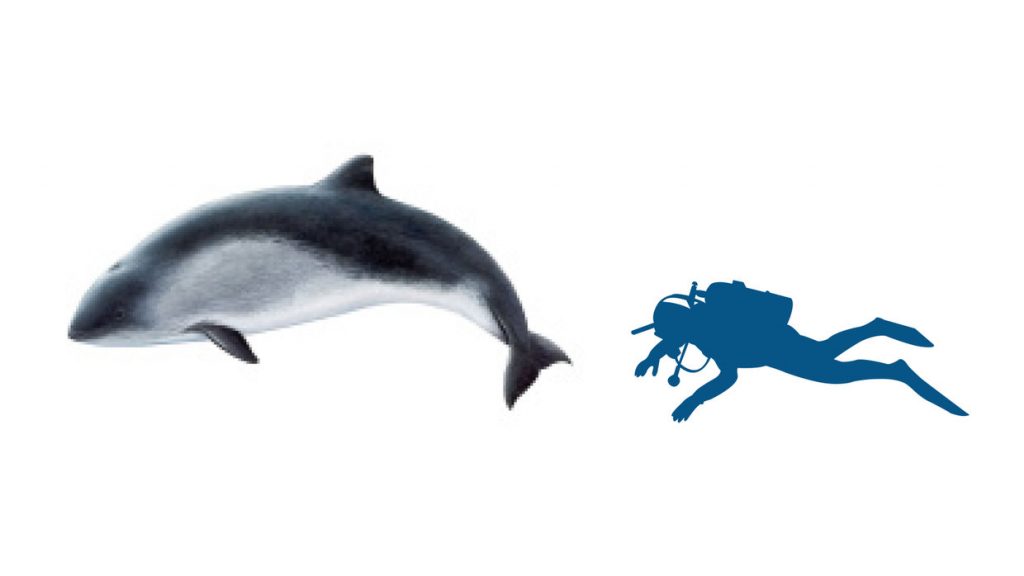
The smallest whales are found in a group of cetaceans which we call porpoises. We regularly spot one of those species in our whale watching tours from Reykjavik, the Harbour Porpoise! Their maximum size is 1.5 m (5 ft) only and they are the smallest whales which exist in the Atlantic Ocean and one of the two smallest species of Cetaceans worldwide.

“A Harbour porpoise is only about 1.5 m (5 ft) long and is one of the smallest species of Cetaceans in the world”
Blog by
Dr. Annemarie Kramer (guide)
The fact that dolphins are whales seems to cause a lot of confusion among people.
The short answer is: Yes, dolphins are a type of whale. If this answer doesn’t satisfy you, continue reading.

Whales, or cetaceans, as the scientists call them, are a group of mammals which are distributed throughout the world’s oceans and even in some freshwater areas. Whales can be divided into two groups, these are called baleen whales (Mysticeti) and toothed whales (Odontoceti). Most whales belong to the group of toothed whales such as all dolphins and porpoises. The main differences between those two groups are, as their names indicate, that toothed whales have teeth whereas baleen whales have baleen plates in their mouth.

Scientists have been trying to classify animals according to their characteristics and appearances and this is how they ended up creating these categories. Modern science and genetic analysis has been changing some of these established beliefs and categories lately, but let’s keep it simple.
Among the group of toothed whales we can distinguish between smaller groups, biologists call these groups ‘families’. The members of each of these groups share similarities, this is why they are grouped together.

There are two families among toothed whales which we refer to when talking about dolphins, one are the Oceanic Dolphins family ‘Delphinidae’ and the other one are the River Dolphins. Altogether there are over 40 species of dolphins! All members of the family of oceanic dolphins (Delphinidae) share distinctive features such, as for example: conical shaped teeth and a beak like extension of their jaws – so these are some characteristics which make a whale a dolphin!
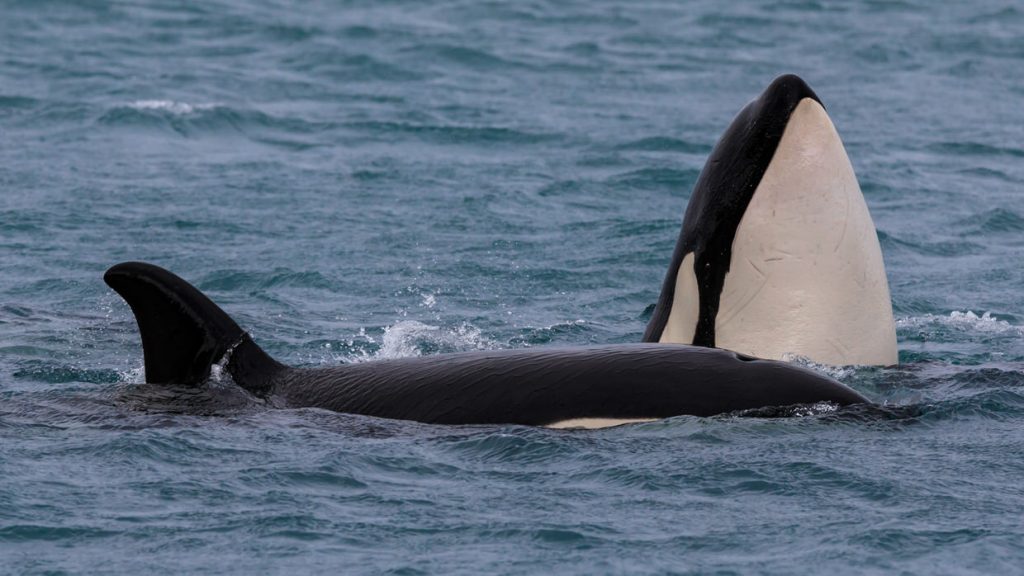
And, by the way, the largest member of the dolphin family is the Orca sometimes also referred to as killer whale which we have spotted occasionally on our whale watching tours in the Faxfloi Bay!

Photo by Federico Facchin
Blog by
Dr. Annemarie Kramer (Guide)
Yes, you most certainly can see puffins in Reykajvik!
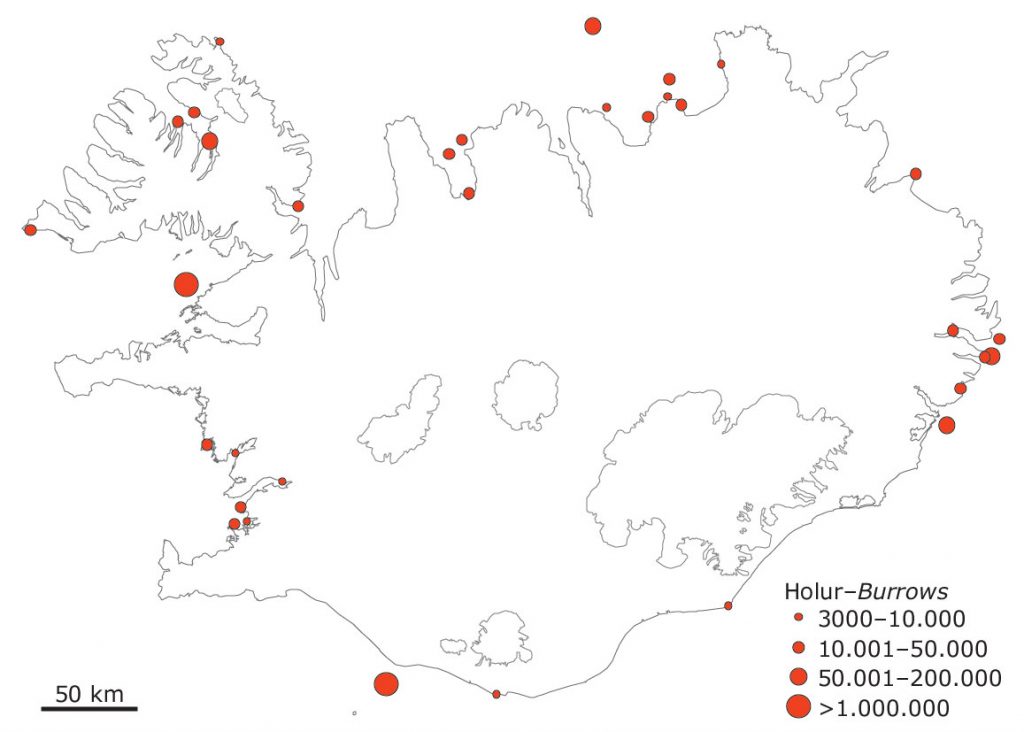
Puffins are seabirds and spend most of their lives out in the middle of the North Atlantic Ocean. However, during their breeding season from May to August, they migrate to Iceland, Norway, Greenland, the Faroe Islands, the United Kingdom and Newfoundland. You can find colonies of puffins all around Iceland during the summer and scientists believe that 60% of the entire puffin population nests in Iceland every summer! But they are shy by nature and they nest in remote places so it can be hard to find them.

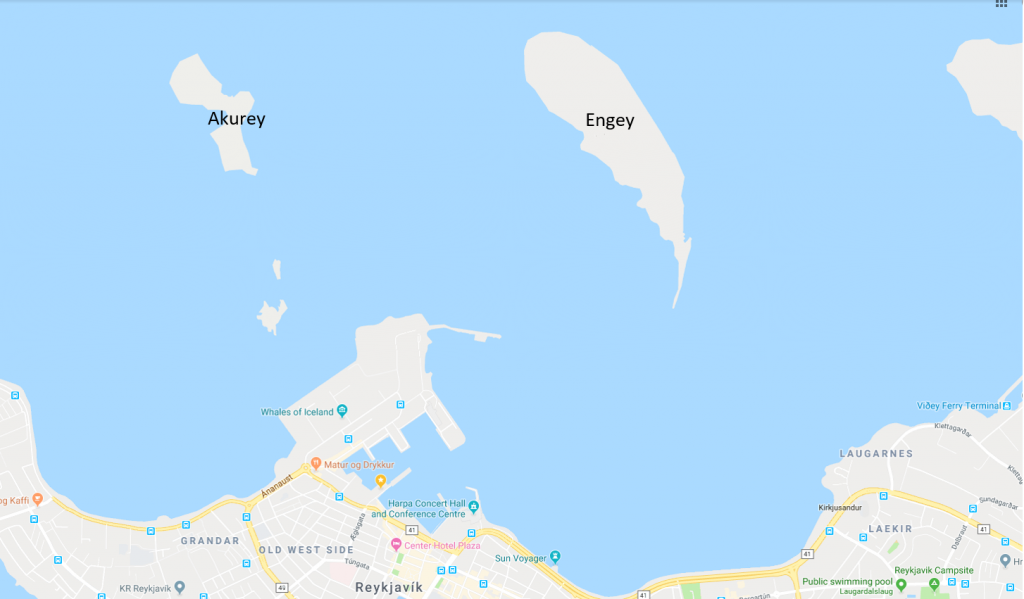
Just outside of Reykjavik Harbor there are two small islands called Akurey and Engey. There is a big puffin colony that nests on these islands, it’s estimated that around 10-15 thousand pairs nest on them every summer. Just when the breeding season is starting scientists go out to the islands to count how many holes are being used by the puffins. That way they can see if the population is declining or not. They went out to Akurey on the 2nd of June 2019 and discovered that there were puffins in 4 out of every 5 holes. That is 8% more than last year so the population is doing great!

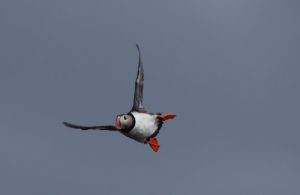
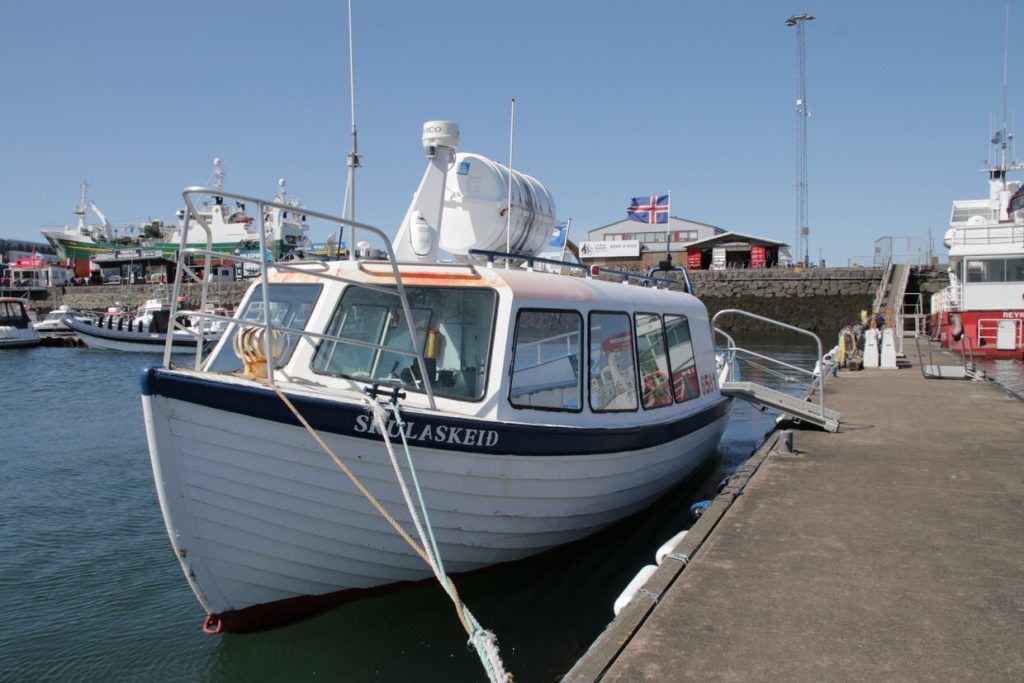
If you want to see puffins from Reykjavik, you can join us on one of our Puffin Express tours! The islands are only a 15-minute boat ride from Reykjavik harbor. We go out on a small wooden boat called Skúli which is built to sail into shallow waters so we can get extra close to the islands. There you can see the puffins in their natural habitat walking around on the islands, sitting on the surface of the water around the boat or flying over. We have about half an hour to cruise around the islands and enjoy the environment.


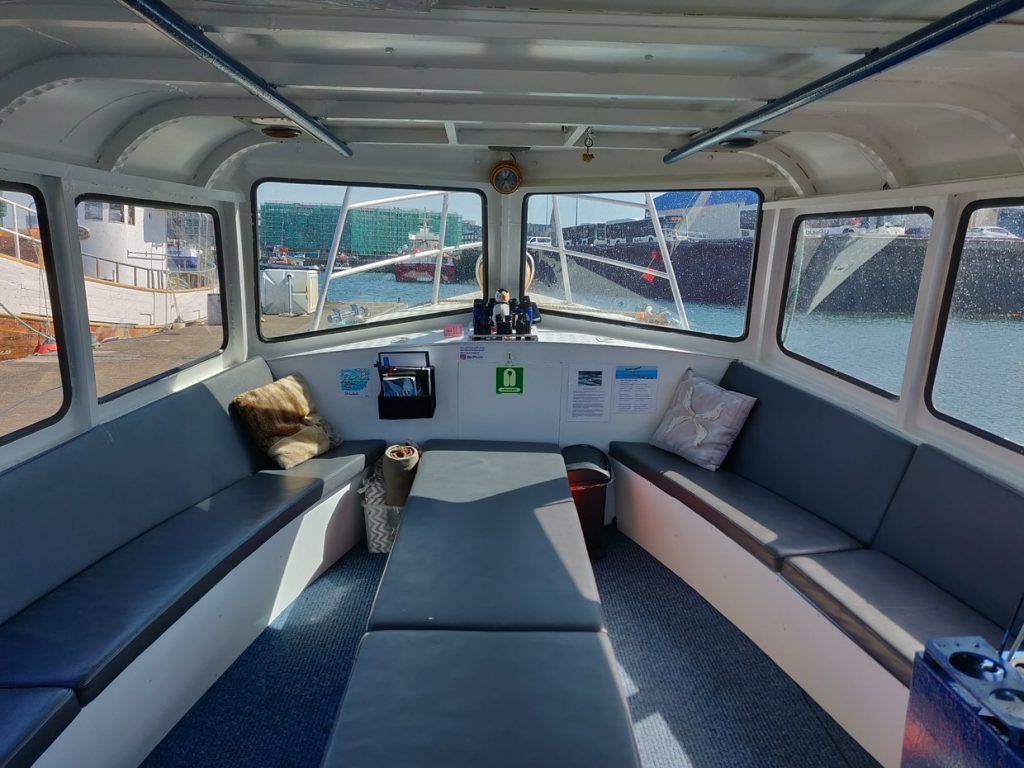
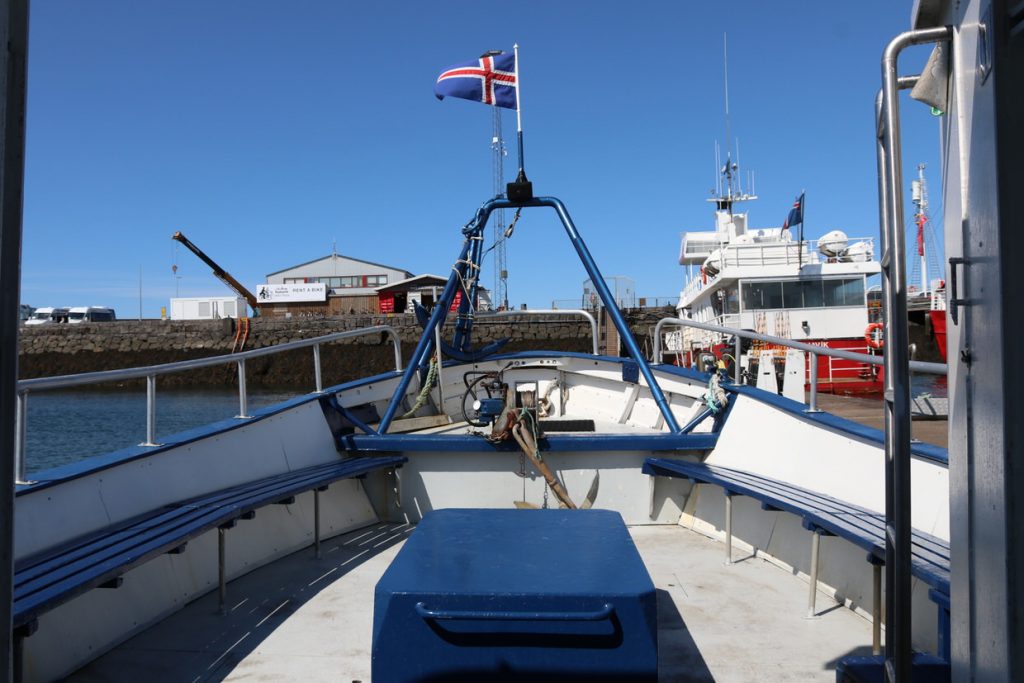
The boat is half overbuilt so you can stay inside or outside, whatever you feel is more comfortable. We provide binoculars on board, a lot of puffin books with extra information and warm blankets for those who need them. The tour is only one hour and is suitable for all ages. It’s the perfect opportunity to experience Icelandic nature and see Reykjavík from a different viewpoint. Just make sure you are dressed according to the weather and bring a long lens camera if you want to get some crystal-clear photos of the puffins because they are small and fast! I recommend to just sit back, relax and take in the nature around you. See more information about our puffin watching tour from Reykjavik here.


Blog by our Puffin Specialist
Íris Thorlacius Hauksdóttir
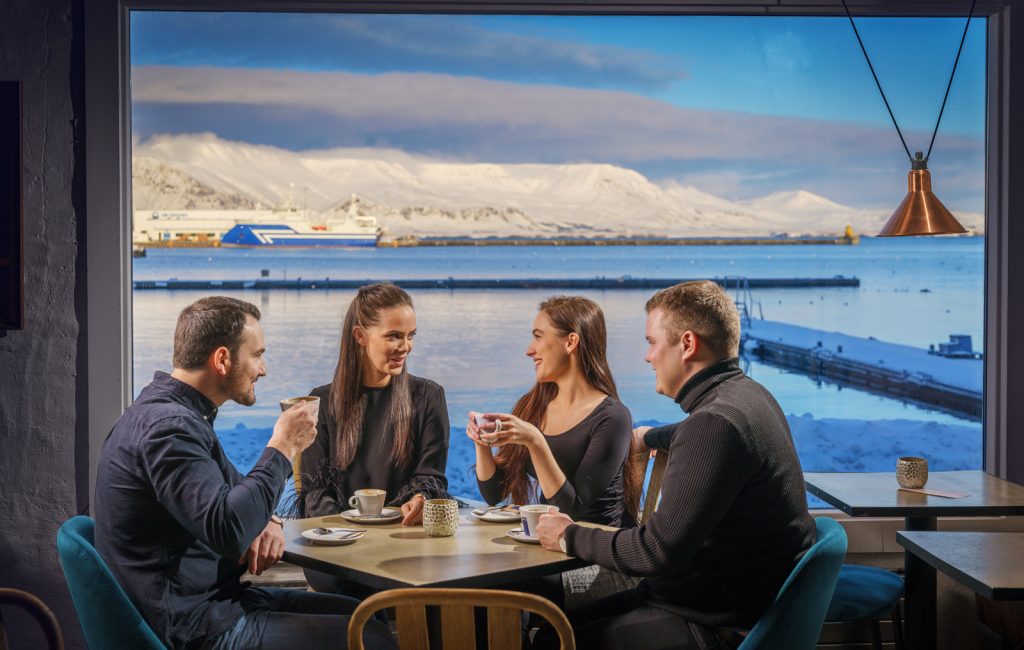
If you’re visiting the Old Harbour in Reykjavik, whether it’s for a whale watching tour, puffin watching tour, northern lights tour, or even just a leisurely stroll by the sea, the salty sea air can easily stir up an appetite! Depending on what you’re in the mood for, there is always something delicious within just a few minutes’ walk – and a freshly brewed cup of coffee can be the perfect pick-me-up. Here’s our article on the best coffee in the Reykjavik Harbour!

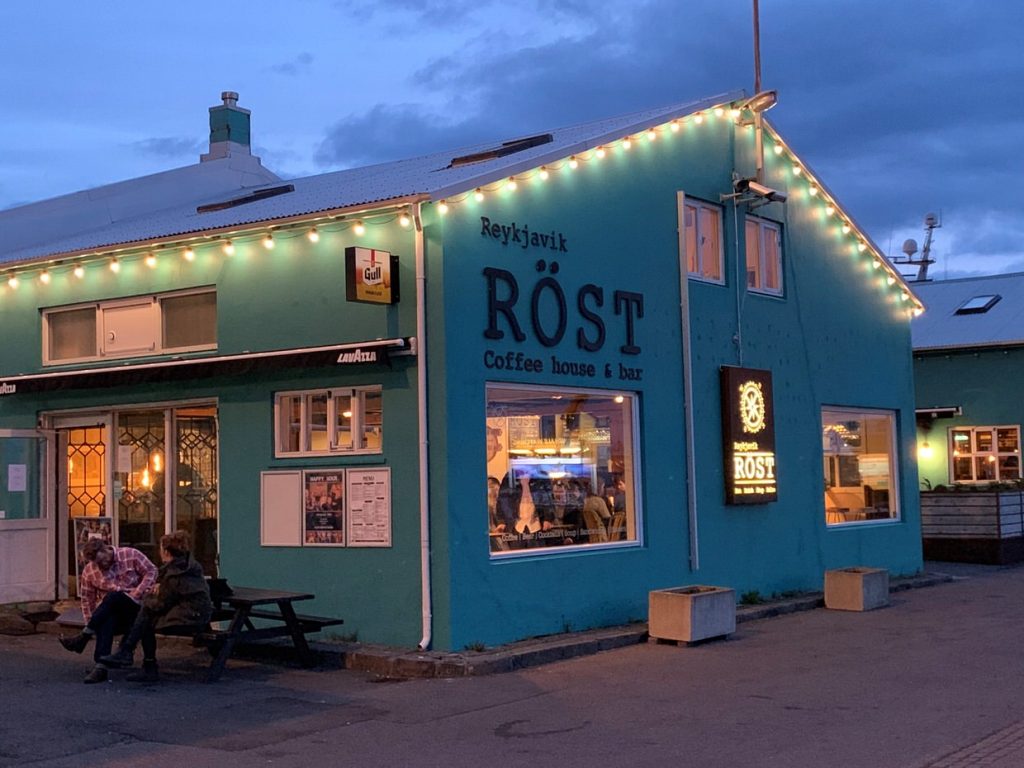
For coffee to go or coffee to be enjoyed with one of the best views in Reykjavík, look no further than Reykjavik Röst. This cozy little coffee shop, bistro, and bar opened in July 2017, and it quickly attracted both locals and foreign visitors alike. Röst (pronounced “rust”) is an Icelandic word for a place where strong tidal currents meet shallow waters, so its name matches perfectly with its seaside location. It’s located in the middle of the Old Harbor, right next to where all the tour boats dock.

Reykjavík Röst serves up Lavazza coffee, a nice variety of other hot drinks, freshly-made sandwiches and soups, and amazing meat and cheese platters. They also have one of the best happy hour specials in town, with discounts on draft beer and wine from 15:00 until 19:00 (3pm – 7pm). The large windows provide amazing views over the harbor area, including the fjord Kollafjörður and Mount Esja, so you can sip your coffee and watch the world (and boats) go by. And best of all? Special Tours passengers receive 15% off all menu items!
Blog by
Jonathan Rempel
Instagram: @jon.rempel
Head Guide of Special Tours Wildlife Adventures
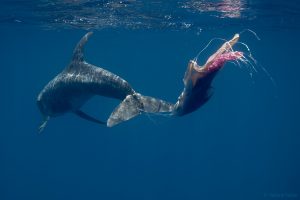
Here at Special Tours, we take joy in showing off the wonderful animals that feed in the bay of Faxaflói throughout the year. As a whale-friendly company, we are strongly committed to the idea of sustainable tourism, and we always do our best to minimize our disturbance on these amazing mammals on our tours. Protecting whales, dolphins, and porpoises (collectively known as cetaceans), however, also involves knowing what threats they face around the world. Unfortunately, whales face a variety of threats, which are mainly due to human activities. To raise awareness, we would like to highlight some of the main direct threats to whales and talk about what you can personally do to help reduce these impacts.

Photo by Andrew Sutton, WDC Ambassador
Every year, millions of tons of plastic enters the oceans around the world. The main land-based source of this pollution is runoff from landfills next to bodies of water. Rainwater causes trash to flow into rivers, which then flow into the ocean. Meanwhile, out at sea, illegal dumping from ships contributes a lot of pollution as well. All this trash can be extremely noticeable in some spots – for example, there is a massive garbage patch in the north central Pacific Ocean that has reached a staggering size, as much as 1.6 million square kilometers. That’s more than 15 times the size of Iceland!
This plastic can take extraordinarily long to break down – for example, a normal plastic shopping bag can take up to 1000 years! When plastics break down, they create tiny particles called micro-plastics which then circulate throughout the ocean, making their way into the food chain and are eventually eaten by whales – or even humans. This is a large problem because the chemicals used to manufacture these plastics can be toxic, and some are known to cause diseases and birth defects. If whales ingest large pieces of plastic directly, it can cause them to choke, or fill up their stomachs and lead to starvation.

If you stop the use of single-use plastics, such as straws, cutlery, and shopping bags, you can not only help reduce the demand for these products, but also lower your personal contribution to this plastic nightmare. Instead of plastic straws, choose easily biodegradable paper straws, or reusable metal ones. Instead of plastic cutlery, keep a metal fork and knife in your car, or you could even choose biodegradable, plant-based “plastic” cutlery, such as by Vegware. And bring a sturdy, reusable shopping back with you to the supermarket.
If you want to go a step further, you can ask businesses you shop at, and restaurants you eat at, to consider switching away from single-use plastics. Those plastic take-out containers might keep your food safe on the trip home, but thick paper cartons will do the job just as well. And if you’re out for a walk and notice a plastic six-pack holder or shopping bag on the ground, take the minute and place it in a nearby bin. These are small steps, but if we all follow them, then they will make an impact.

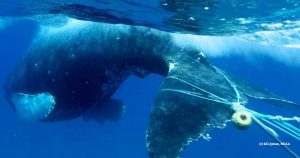
Photo of entangled humpback whale by Ed Lyman, NOAA
Whales of all sizes are vulnerable to entanglement in fishing gear, and this risk only increases as fisheries around the world grow in size. What may happen is that a dolphin or porpoise sees fish caught in a net, and may try to eat them, getting itself entangled. Or, the thin filaments used in these nets may just not be visible to these animals, and so they become entangled by mistake. Because whales are mammals, and they must rise to the surface to breathe, this can cause these animals to drown. If they survive these entanglements, the fishing gear can leave wounds, infections, and result in scars to form.
A recent study which analyzed these scars concluded that a significant percentage of all humpback whales spotted in Icelandic waters have been previously entangled in fishing gear (Basran et al., 2018). These incidents might happen anywhere along their migration route, and they aren’t just from nets that are actively being used – whales may also become entangled in “ghost nets”, or nets that float around, unused, having been broken off or discarded carelessly. Ghost nets not only pose an entanglement threat, but also contribute to plastic pollution – see above.
The world’s smallest whale, a species of porpoise known as the vaquita, is unfortunately also the world’s most endangered whale. This is entirely due to entanglements – in their habitat, the Gulf of California in Mexico, an illegal gillnet fishing industry exists to hunt the totoaba, a large fish species. Vaquitas unfortunately become entangled very easily in these nets, causing them to drown. The most recent population estimate of this species is only 30 individuals, and so they are on the brink of extinction.
If you do any recreational fishing in areas where dolphins or porpoises might be found, it is important to always pull your line up if they approach the boat, and to never feed wild cetaceans. If they become very used to fishing boats, this puts them in danger of getting entangled in nets or fishing line (or even swallowing a fish with a hook in it – ouch).
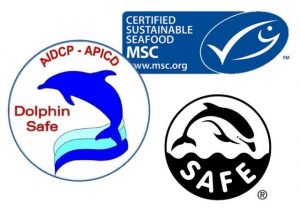
If you aren’t a fisher, but you buy seafood, make sure to always look for “sustainable seafood” or “dolphin-safe” labels on the food you buy. The fishers these companies obtain their food from conduct their catches in a way that is as safe as possible.
If you are by chance a commercial fisher, then there are ways to reduce the chances of cetacean entanglement, such as affixing pingers to the nets – small devices which emit sound and make them easier for animals to detect. They are very low-cost, only about €4.50 per year per kilometer of fishing net! And soon, a type of net that includes barium sulfate should become more widely available – this compound makes fishing nets much easier to “see” using echolocation, which toothed whales use.

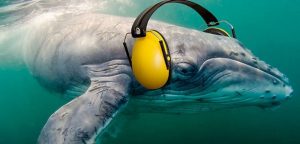
It would be nice to hand these out sometimes. Image from OceanCare
The ocean is a noisy place! The three main sources of noise pollution in the ocean are ship noise, gas and oil exploration, and sonar from military vessels. The largest ships that sail across oceans, such as container ships, oil tankers, and cruise ships, need incredibly powerful engines to power them – some more than 100,000 horsepower, and guzzling up to 16 tons of fuel every hour. And all that machinery makes a lot of noise, in the same range that whales use to communicate. This interferes with their ability to hear, including echolocation, and can sometimes result in them being struck by ships – but more on that later.
When oil and petroleum companies scout out potential areas to place oil rigs and start drilling, they first conduct seismic surveys to analyze the geology of the seafloor to check if there could be oil underneath. The air guns used in these surveys produce incredibly loud and intense bursts of noise, meant to penetrate hundreds of kilometers into the ocean floor. And these bursts can be disastrous to marine life, killing not only cetaceans but also seals and zooplankton. Whale stranding’s are often associated with these surveys. Farther away the effects are reduced, but they can still damage whales’ ears, or cause them to stop breeding. Overall, the effects of a single seismic survey may cover 300,000 square kilometers – 3 times the size of Iceland.
Another major source of mass stranding’s is from the use of sonar by military ships, especially during exercises and practices. Sonar began to grow in popularity around World War II, when it was used mainly to locate submarines. But the frequencies used in this sonar can be very harmful to whales, either causing direct injuries such as ear damage, or causing them to panic and surface too quickly, leading to decompression sickness, like human scuba divers can get. This can especially affect beaked whales, the deepest-diving of all mammals. Dozens of mass stranding’s over the past decades have been associated with naval sonar, but because these military activities are often classified, there may be many other mysterious mass stranding’s that could have been caused by sonar as well.
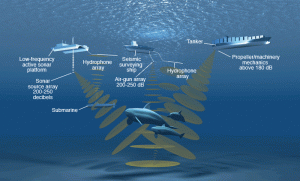
Image from NOAA
Further development of renewable energy that doesn’t rely on fossil fuels, as well as reductions in these military sonar exercises, would go a long way towards making the oceans a quieter place. And if you do decide to go whale watching, either here in Iceland or elsewhere in the world, make sure to choose a company that follows all local regulations – and even better if they adhere to a Code of Conduct. These companies do their best to minimize sound production from engines and propellers while whales are in the area. The Icelandic Whale Watching Association (IceWhale) has been maintaining its Code of Conduct since 2015.
If you are the skipper of a recreational fishing boat, and dolphins (for example), happen to approach the boat, turning off your fish finder might just reduce the noise that these animals must deal with every day.

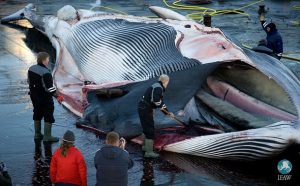
Photo of fin whale being processed, courtesy of IFAW
Whaling as a practice has existed for thousands of years. In times of starvation, a single whale could feed a hungry village for weeks. But this whaling for survival, or “subsistence whaling,” is far different from the commercial whaling that still unfortunately exists today. The whales that swim in our seas today form just a fraction of their numbers from before commercial whaling came along. A recent estimate suggests that during the 20th century (1900-1999), nearly 3 million whales were hunted as part of commercial whaling, and hundreds of thousands more over the previous two centuries.
Today, there are only 3 countries that still allow the practice of commercial hunting: Norway, Japan, and Iceland. Here in Iceland, the 2 species that have been hunted over the past few years are the fin whale and minke whale. While the minke whale population has not been listed as threatened, fin whales have been added to the IUCN Red List of Threatened Species, and have been classified as either vulnerable, or endangered. All countries that allow commercial whaling claim to have quotas that result in sustainable catches, which would not affect the overall population long-term – but it is very difficult to estimate their population in the first place.
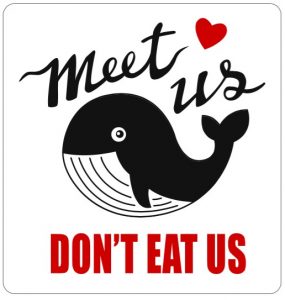
Minke whale meat is unfortunately still served in restaurants and sold in supermarkets here in Iceland. But only a minority of Icelanders still eat whale meat – the most recent survey revealed less than 2% of Icelanders eat it on a regular basis, and more 80% never eat it. Most of the demand comes from foreign visitors. While you are here, make a point to choose “whale-friendly” restaurants. Many of them have pledged to not serve whale meat, by placing a sticker in their window that says, “Meet us, don’t Eat us!”
Ending whaling in whale watching areas has already revealed noticeable impacts. In Summer 2018, when the minke whaling season stopped partway through, whale watchers in Faxaflói Bay began to see a noticeable increase in curious minke whales that would approach boats.
You can also add your name to the petition organized by the International Fund for Animal Welfare (IFAW), to help show the world that eating whale meat is indeed a dying practice: https://ifaw.is/signup/.

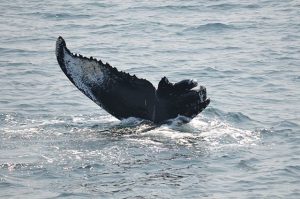
Bayou, a humpback whale spotted off the coast of Massachusetts, is believed to have been struck by a ship to produce this unique tail. Photo from Boston Harbor Cruises
Whales being struck by boats and ships is a widespread issue that can affect any species swimming where vessels may also travel. Although in general, whales react and respond to danger very quickly, in some cases their ability to react (and escape) can be reduced. For example, if they are resting, nursing a calf, feeding, or even reproducing, they may be less aware of their surroundings and become more vulnerable to being hit by a vessel. In nearly every well-studied whale population, individuals have been found bearing the marks of ship strikes, from injured dorsal fins to scars on their backs. Unfortunately, many whales do not survive these encounters.
The North Atlantic right whale, the most endangered of baleen whales due to centuries of whaling, now faces a new threat in ship strikes. As commercial shipping increases every year, passing through their habitats, they become more at risk. And because climate change is reducing the amount of Arctic sea ice that stays throughout the year, more potential shipping routes are opening up, further adding to this risk.
Photo from BearandBlue.com
In the United States, the states of Massachusetts and California created laws in 2009 and 2013, respectively, to redirect shipping channels going through areas where many whales can be seen, in an effort to reduce ship strikes. If this continues around the world, and in other countries, then we may be well on our way to help reduce this issue.
When piloting small recreational vessels in coastal waters, make sure to always obey all posted speed limits and signs with “No Wake” warnings. Not only do these help prevent accidents with other boats, but going at a steady pace can help skippers more easily notice and avoid marine mammals such as whales, dolphins, porpoises, seals, and manatees.
Blog by Jonathan Rempel
Instagram: @jon.rempel
Special Tours Head Guide
Visiting Reykjavík in December is an experience you don’t want to miss! Below are some ideas to make the most out of your December trip to Reykjavík.
Laugavegur and Skólavörðustígur are the main shopping streets in Reykjavík. While you walk around taking in the city’s radiance it is well worth giving these streets a visit. Around this time the city is starting to take on its beautiful Christmas form with decorations, Christmas lights and a contagious atmosphere which is reflected on the streets and in stores and restaurants. Grab a hot chocolate and enjoy while looking at the many shops and restaurants that these streets have to offer.

If you need to warm up after your walk, then Reykjavík Röst is a great option!
Reykjavík Röst is a coffee house/bar in the Old Harbour in Reykjavík and was opened in the summer of 2017. They pride themselves on their quality coffee and homemade grilled sandwiches on sourdough bread. They also have vegan options; the soup is always vegan as is one of their sandwiches. Their hot chocolate is made with real chocolate and steamed milk + whipped cream and some cocoa & cinnamon powder. They have four different beers on tap, a full bar, bar snacks and platters in the evening with an amazing harbour view. It’s the perfect place to sit down, enjoy great views over the harbour and Reykjavík´s surrounding mountains while sipping on a hot or cold beverage.

Photos by Ragnar TH
December is a great month if you want to try your luck hunting for the Northern Lights. Escaping the light pollution from the city is a must when hunting for the Northern Lights. Our favorite Northern Lights tour to join is the Northern Lights by Boat tour from Reykjavik’s Old Harbour, but of course we are a bit biased. Seeing the colorful auroras dancing in the sky combined with a boat tour is a spectacular adventure and a great way to end your day! It can be cold, but no worries – you will be provided with warm overalls and there is a café/bar on board, so you can grab a hot coffee or chocolate while enjoying the beautiful aurora view. Make sure to check out our post regarding all the things to know before your Northern Lights by Boat adventure to maximize your experience.

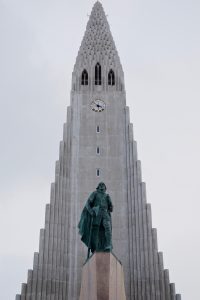
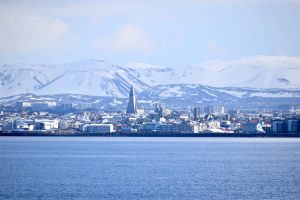
Hallgrimskirkja church is one of the best viewing spots in the Reykjavik area, especially when the Christmas season is in full swing. The beauty of the lights combined with the white snow will truly raise your holiday spirits to another level (yes we are hoping for a white Christmas). Your perfect Reykjavik photo can be captured, and the view is just spectacular. You may even hear the church bells ring!

Photo by Wesley Gibbs on Unsplash
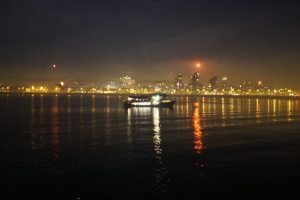
A Whale Watching trip that offers a beautiful view of Reykjavik’s Christmas glow from the sea is the perfect experience while staying in Reykjavik. You will sail out to Faxaflói Bay for your whale watching tour, and as we sail out you get a great view of Reykjavik’s shore. On the tour you will be searching for the whales of Faxaflói Bay which may be everything from dolphins and harbour porpoises to minke whales and humpback whales. Make sure to check out our articles before your tour including some tips on how to photograph whales and info about Winter Whale Watching from Reykjavik. Seeing whales in their natural habitats is such a great experience and going whale watching from Reykjavik can be just magical!

Photo by Federico Facchin
The Icelandic swimming pools and hot tubs are well engraved in the Icelandic culture. It’s a very typical afternoon for the inhabitants of Reykjavík to lay back and relax at the hot tub followed by a hot sauna or a swim. All of the pools are heated by Icelandic geothermal water coming from the beneath the ground. The swimming pools are a great option to warm up after a cold December day, whether you have just been walking around town or if you enjoyed a whale watching tour or a day tour from Reykjavik to the Golden Circle, West- or South coast. Here you can see some of our favorite tours and combo tours available from Reykjavik.
Ice skating at the Ingólfstorg Square is a heart-warming experience in the heart of Reykjavík. The skating rink is right in the middle of the small Christmas Village at Ingólfstorg Square where you can stop by for some goods and refreshments after your Ice-Skating experience.
There is nothing more Christmassy than ice skating while listening to Christmas songs in Reykjavik’s lively downtown environment.
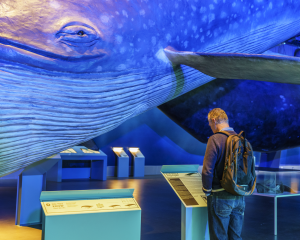
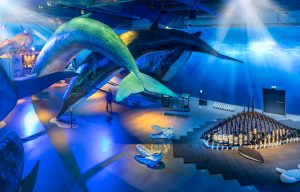
The Whales of Iceland museum is a great way to spend part of your day while staying in Reykjavík. Get an idea of how big these creatures are while viewing the hand painted, life-size models. Whales of Iceland is the largest whale museum in Europe, including 23 live-size species that can be found in the surrounding waters around Iceland, including their history and facts. Standing beside these full-size creatures is simply adventures and the museum is a must for those staying in Reykjavik.

Photos by Ragnar TH
For those who like skiing, Bláfjöll Ski Resort is only a 25 minute ride from Reykjavík. The area has a variety of ski slopes to choose from for downhill skiing and snowboarding as well as tracks for cross-country skiing. Bláfjöll is a fun and an enjoyable day trip for individuals, couples, friends and families from Reykjavík
Despite the cold winters here in Iceland, it is a well-known fact that Icelanders love ice cream. Every night long lines from in front of ice cream shops, and it’s no coincidence since we have plenty of high standard ice cream shops in the Reykjavik area. If you’re too hot after your hot chocolate or simply want to see what’s the fuss is about, then we recommend getting an ice cream no matter the weather!
And one extra in case you are planning to stay in Reykjavík on New Years eve
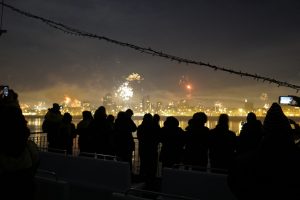
If you are planning to stay over the New Years we highly recommend that you check out the New Years Fireworks cruise with Special Tours Wildlife Adventures. Reykjavik is world famous for it´s crazy fireworks display where each family purchases their own fireworks and bring them to the streets around midnight to fire them up and then the best place to be is out at sea so you can see the whole panoramic view of one of the most crazy and spectacular fireworks display in the world.

Photos from 2017-2018 Fireworks Cruise with Special Tours
Blog By Gunnar Kristinn Jónsson
Featured Image by Roan Lavery on Unsplash
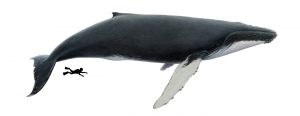
Whales can come in all shapes and sizes. The smallest whale in the world, the vaquita, grows barely larger than a 10-year-old child. Meanwhile, the largest whales can grow to be larger than a city bus, longer than a basketball court, and even as long as a Boeing 737 passenger jet! Despite being so large, some of these massive marine mammals maintain their size by feeding on tiny animals, many of which are only the size of a paperclip.

Picture: The size of a Humpback whale compared to a diver.
Whales, dolphins, and porpoises are all classified as cetaceans, which evolved from land animals over the past 50 million years. Scientifically, cetaceans are classified into two groups: the toothed whales, and the baleen whales. The largest whales are baleen whales, but size isn’t the best way to distinguish between the groups. Instead, we should look inside their mouths to determine which group a whale belongs to!
The 2 most common baleen whales we see on our whale watching tours from Reykjavík are the minke whale and the humpback whale (See more about Humpback whales in our blog about how to identify Humpback whales). These species migrate thousands of miles every year, or almost every year, to come to Iceland and feed in our nutrient-rich waters. This results in spectacular sightings which may occur throughout the year, but sightings reach a peak in the summertime.

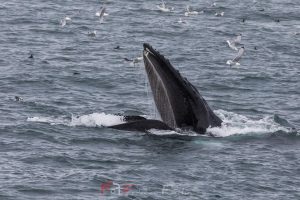
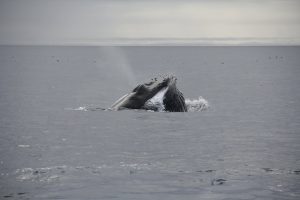
A feeding baleen whale is an amazing and often dramatic sight to behold!
Both pictures show a feeding humpback whale seen on a whale watching tour from Reykjavík with Special Tours.
Picture 1 by Federico Facchin / Picture 2 by Sigfús Már Pétursson
These baleen whales don’t have any teeth – and that’s because their remarkable way of feeding has made teeth useless. Instead, they have long strips of keratin (the same material our hair and fingernails are made of) which hang down from their upper jaws, inside their mouths. These strips are called baleen plates, and the whales use them to filter out their tiny food from the seawater!

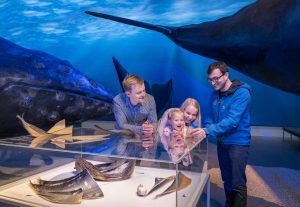
A sample of actual baleen plates at the Whales of Iceland museum in Reykjavik, an amazing add-on to any whale watching tour or a perfect way to spend some time either way! Picture by Ragnar TH
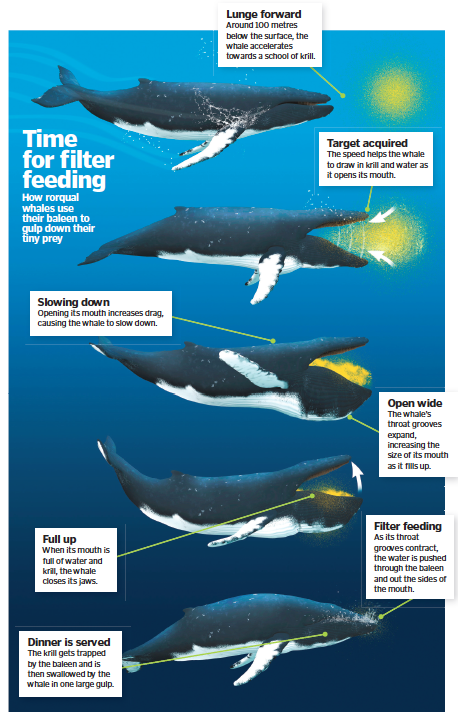
Baleen whales have hundreds of these plates in their mouths, and they use the narrow gaps between the plates to filter out their food. They feed by opening their mouths wide, allowing a massive amount of seawater (along with their prey) to rush in. When the water and food are inside their mouths, they close their jaws and use their tongues to push the water out. The prey is trapped inside the mouth, held in place by the baleen plates acting as a sieve, and once all the water is expelled, they swallow everything in one gulp.
Both minke whales and humpback whales belong to a group of baleen whales called the rorquals, which have pleated throat grooves. These lines run underneath their bodies, from their mouth to their navel, and allow their throats to expand like an accordion to hold an incredible amount of seawater at once – 70 tons in the case of the blue whale, the largest rorqual of all!
These whales repeat this process of filter-feeding throughout the day, every day. Humpback whales can consume up to one ton of fish and krill per day! This comes in handy, as they stop eating once they leave the feeding grounds and head south towards warmer waters, where they mate and give birth.
The first filter-feeding whales appeared in the fossil record around 25-30 million years ago, and before that point all whale fed using teeth. Today, nearly all the whale species on Earth are toothed whales, which are also amazing in their own ways – but they will be covered in a future article!
Watching these gentle giants feed in their natural habitat is an incredible experience, and something our whale watching crew never gets tired of. Join us on one of our Whale Watching Classic, Whale Watching Express, or RIB Express tours, and you might just get to witness it as well! When planning a Whale Watching tour we definitely recommend reading our blog about How to Photograph Whales.
Blog by Jonathan Rempel
Instagram: @jon.rempel
Special Tours Head Guide
Winter is such a magical time of year to come visit Iceland! Despite the short daylight hours, there is still so much that you can do. Seeing the otherworldly landscape around the country powdered with snow is breathtaking, and if you’re lucky you might even catch the Northern Lights, an amazing natural phenomenon that deserves to be on everyone’s bucket list. We also offer whale watching tours year-round, even in the middle of winter!
People are often surprised to hear that we go whale watching in the winter. After all, the summer months (April – September) are our “high season” due to the long daylight hours. But actually, it is possible to see cetaceans (whales, dolphins, and porpoises) on any given day of the year. In this blog post, I wanted to share some information and advice for those wishing to go whale watching in the wintertime from Reykjavík. Just note that most of the information in this blog post applies to whale watching tours that sail from October until April.

Photo: Reykjavík in winter
For our whale watching tours, we set sail from the Old Harbor in Reykjavík, out into the feeding grounds of Faxaflói, the largest bay in Iceland. Our Whale Watching Classic tour is 3-3.5 hours long, giving us plenty of time to enjoy the sailing and admire the beautiful landscape, all while searching for our whale friends. But not all whale watching tours are created equal, and they can vary depending on the season.
For example, some of the animals that we see on our tours are seasonal. Minke whales spend their summer months here feeding and bulking up before heading southwards to breed and give birth. Their winter whereabouts are currently unknown, but one study suggests they may head down to the Canary Islands in the winter. Minke whales are the most commonly sighted species on our whale watching tours in summer, but they are very rare during the winter.
However, humpback whales may visit Faxaflói at any point in the year – and indeed, during the winter, humpbacks are the most common species of large whales that we spot on our tours. The migration of humpback whales in the North Atlantic Ocean is poorly understood. Indeed, many humpback whales do not leave Iceland at all during the winter, instead choosing to stay and feed in the rich, nutrient-rich waters around the country.

Photo: Feeding humpback whale in Faxaflói Bay
But whales come in all sizes! The toothed whales that we see on our tours, the white-beaked dolphins and the harbor porpoises, do not migrate, and so stay around Iceland all year round. We tend to see many of them throughout the year, and these toothed whales are the two most commonly sighted species during the winter months.
The bird life changes as well during the winter months. The most common bird species are northern gannets, beautiful large seabirds which can plummet into the sea from high in the air to hunt for prey, northern fulmars, a close relative of the albatross which can live for 50 years or more, and great black-backed gulls, the largest gull species on Earth. We also spot other species such as common guillemots, Iceland gulls, Manx shearwaters, and more. You won’t find any Atlantic puffins or arctic terns here in the winter, as they only visit Iceland during the summer to nest and lay eggs.

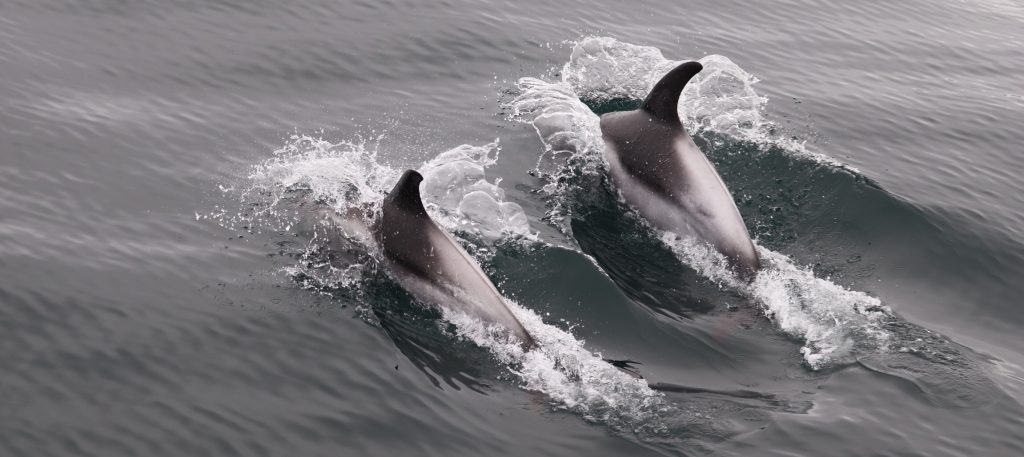
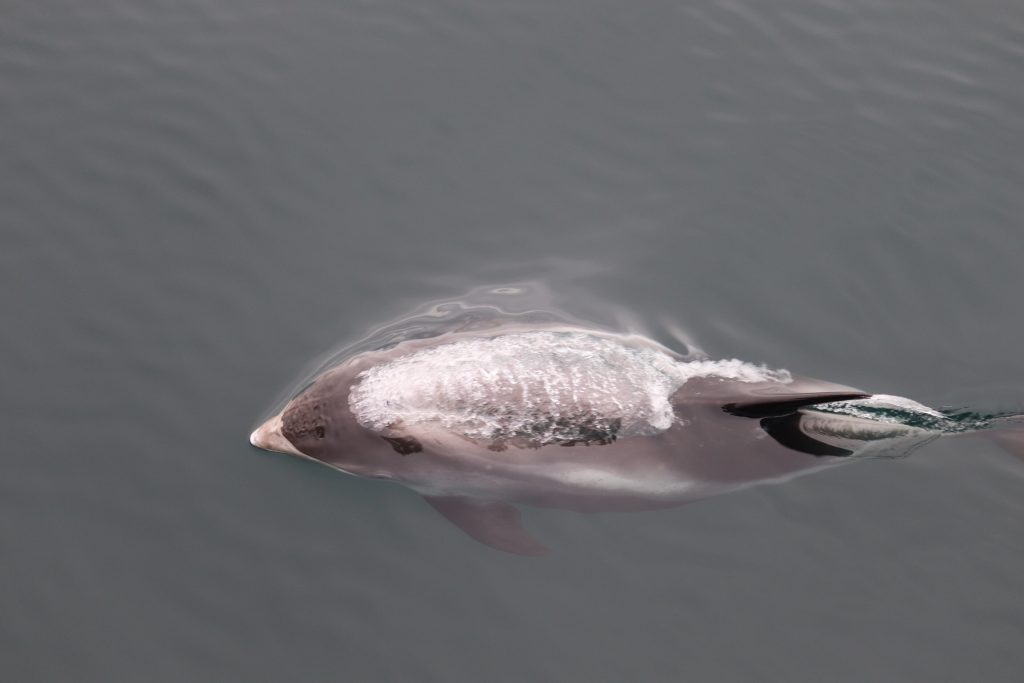
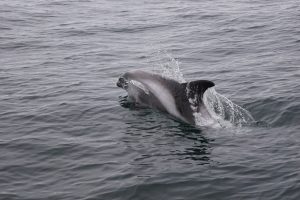
Photo: White-beaked dolphin (see more info in our blog about how to identify a White-beaked dolphin)
Things to Know Before you Go
Iceland is located close to the North Atlantic Current, which brings warmer water to our shores. This means that temperatures here are surprisingly “warm” considering our subarctic location. But out at sea, things can get very cold, very fast! We always provide free thermal overalls to our passengers to help keep them cozy during our adventures, but you still need to bring warm clothing to wear underneath. Think layers – a thermal base layer, a thicker mid-layer (an Icelandic wool sweater is perfect for this), and something windproof on top to really trap the heat. Wool socks and sturdy hiking shoes or boots will keep your feet toasty, and also stable, as things can get icy around Reykjavík and the Old Harbor. And don’t forget a hat, gloves, and a scarf.
Weather in Iceland can be unpredictable, regardless of the time of year. But during the winter, it tends to get much windier. At times this can result in rougher seas, so if that happens, then get ready for an exciting adventure! It can happen sometimes that the sea conditions are too rough to sail from Reykjavik, and they are better elsewhere. In cases like those, we will sail from a different harbor, and provide our passengers with free round-trip transportation from our ticket office to the harbor. Just keep in mind that other harbor may be up to a one hour drive away, and so this could extend the total tour time by up to 2 hours. In cases of unfavorable sea conditions, we always cancel our tours if conditions become unsafe.
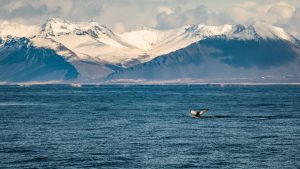
During the winter, the daylight hours are very short – only about 4 hours in the middle of winter. As a result, we only offer one whale watching tour per day, departing at 13:00. So, plan your schedule accordingly. However, there is something dreamy about seeing the sun hang low in the sky, illuminating the snowy mountains while we search for whales. You can often get some beautiful photos of the area like this!

Photo: Federico Facchin
The last thing to keep in mind is that we are at the mercy of nature and wildlife on our Whale Watching tours. We cannot control the amazing animals we search for, nor would we ever want to. Most of the time, they do decide to appear for us, and we get some very nice sightings as a result. But it can happen sometimes, and a bit more often in the winter, that as the animals move around in and out of the feeding grounds, they decide not to show themselves off. If this does happen, we offer our passengers a free ticket to try again, which never expires. But think of it like this – that’s like getting two boat tours for the price of one!
And if you’re looking for a fun and educational add-on to your whale watching tour, then I highly recommend visiting the Whales of Iceland museum at some point during your stay. There’s nothing like it anywhere else in the world, and you can walk amongst these gentle giants and explore life-sized models of 23 different cetacean species. Special Tours passengers can purchase museum tickets separately for a fraction of the usual cost, or you can book a combo tour that provides you with a whale watching ticket, and museum admission, for the same price. I think it’s the coolest museum in Iceland – but then again, I’m a bit biased!
Regardless of the time of year you decide to go whale watching in Reykjavík, by choosing Special Tours you will be guaranteed an adventure led by an experienced crew, and a friendly and knowledgeable guide, aboard one our comfortable sightseeing boats. We have been offering boat tours here for more than 2 decades, and we are always happy to pass along our experience to you!
Blog by Jonathan Rempel
Instagram: @jon.rempel
Special Tours Head Guide
Please note that this blog applies to whale watching tours from Reykjavík from October until early April.